EV Charging Station Franchise Cost: What Real Investors Should Know Before Signing
A practical look at the EV charging station franchise cost across regions, what franchisees actually do, and why the franchisor's distribution strategy — not the hardware spec — is the variable that decides whether the investment pays off.
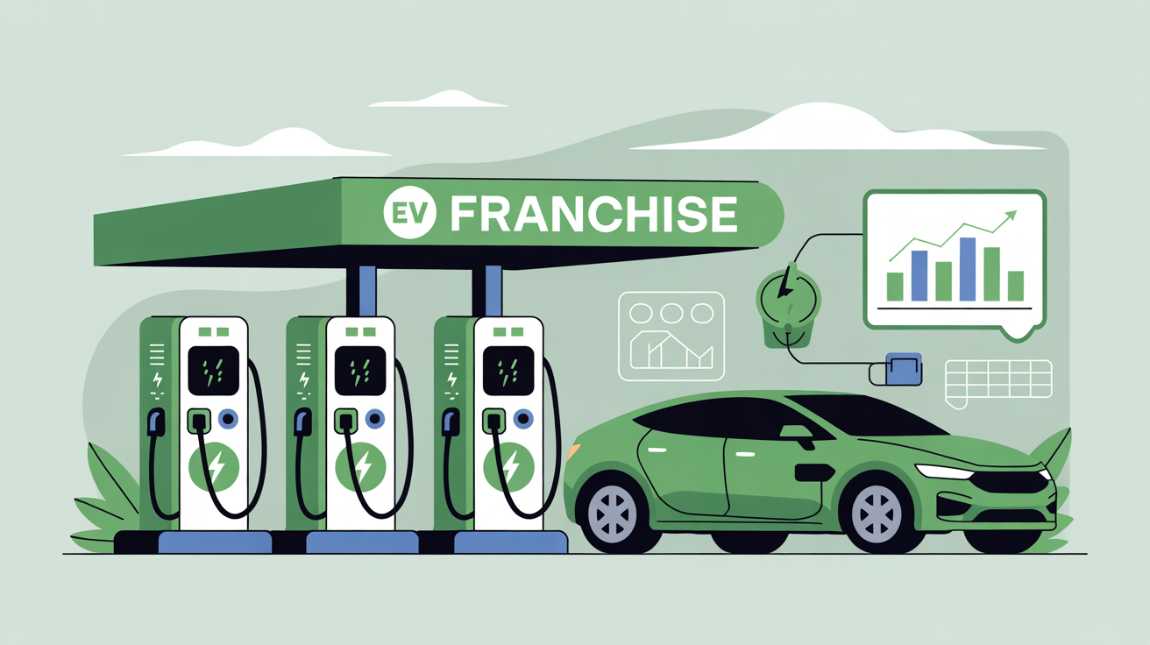
The NetworkCore team speaks with Charge Point Operators across regions every working day. Some are large operators running thousands of stations. Some are small networks just starting out. Many are franchise operators — entrepreneurs who deployed capital into branded charging infrastructure and are now focused on the one variable that decides whether the investment pays off. That variable is utilisation. NetworkCore's role with these operators is to be the distribution channel that brings utilisation — through one integration, at the CPO's public price, settled within days, with a small per-session commission only when sessions actually flow. Our work is to become one of the main distribution channels for the CPOs we work with and a global leader in offering charging as a service to Distribution Partners on the other side of the network. This post is written from that vantage point, for anyone evaluating an EV charging station franchise cost decision in 2026.
A brief history of franchising — and why it works for EV charging
Franchising as a commercial model has existed for over a century in various forms, but its modern shape was set largely by post-war American businesses — McDonald's, Holiday Inn, Hertz — that worked out a structural way to scale a brand and an operational playbook across thousands of locations without owning each location directly. The franchisor brings the brand, the system, the technology, the supply chain, and the demand generation. The franchisee brings the location, the capital, the operating team, and the day-to-day running of the unit. The economics work because each party contributes what they are structurally good at, and the combined operation reaches a scale neither side could reach alone.
EV charging franchises follow this template directly. The franchisor — typically a national or regional charging brand — provides the technology stack, the back-office operations, the relationships with hardware vendors, the integration with payment infrastructure, and the marketing and demand generation. The franchisee provides the location, the upfront capital, and the operational presence at the site. The result is a charging network that scales faster than any single operator could build alone, while distributing the capital requirement across a broader investor base. This is the structural logic that has produced the current generation of charging franchises across every major EV market.
The EV charging station franchise cost for any specific opportunity is determined by where this template lands in commercial detail — the region, the franchise brand, the hardware spec, and the location characteristics.
What an EV charging franchise actually involves operationally
The day-to-day operational profile of an EV charging franchise is, by design, fairly light for the franchisee. The franchisor handles the strategic and operational work that scales across the network: software platform, payment processing, OCPI and roaming connectivity, customer support for drivers, network-wide marketing, brand management, and increasingly the financial and compliance layer across jurisdictions.
What the franchisee actually does is more constrained than most first-time investors expect.
Location, location, location. The single most important factor in the EV charging station franchise cost equation is the location. If you already own or control a suitable site — a retail forecourt, a hospitality location, a workplace car park, a fleet depot — your capital efficiency is enormously improved because the negotiation, leasing, and land-use approval cycles that consume most of the time and risk in a charging deployment are already resolved. If you do not have a location secured, the cost of acquiring one — whether through purchase, lease, or revenue-share arrangement — becomes a substantial proportion of the total deployment cost, and the timeline extends significantly.
Hardware maintenance. Chargers are reliable but not maintenance-free. Periodic checks, occasional repairs, firmware updates managed in coordination with the franchisor, and physical site upkeep all fall to the franchisee. The volume of work scales with the number of chargers and their utilisation, but at any reasonable site size, it is part-time work rather than a full operational role.
Electricity supply. The franchisee typically takes on the wholesale electricity contract for the site. This means securing a competitive tariff with an electricity supplier, understanding peak vs off-peak pricing structures, and where relevant, integrating with battery storage or on-site generation. The margin between the wholesale electricity cost and the retail charging price is one of the primary economics of the operation, and getting the wholesale side right is part of what the franchisee actually controls.
Local compliance and physical site obligations. Permits, inspections, accessibility compliance, safety signage, lighting, and the standard obligations of operating commercial infrastructure at a physical location.
That is, broadly, the franchisee's job. The franchisor does the rest — and crucially, the franchisor does the distribution. The franchisee's chargers fill with sessions because the franchisor brings drivers to them, through whatever combination of branded apps, roaming partnerships, fleet agreements, and increasingly through demand platforms like NetworkCore.
The passive income angle — and where it really comes from
The reason a serious investor looks at an EV charging station franchise cost as an attractive opportunity is the passive income profile. Once the site is operational, the day-to-day workload is light, the revenue is recurring, and the underlying market is growing structurally as EV adoption accelerates. The franchisee puts capital in at the start, manages a relatively contained set of operational responsibilities, and collects a share of session revenue indefinitely.
The passive income works if utilisation works. This is the most important sentence in the entire franchise evaluation. A franchise that produces enough sessions per day to keep the chargers utilised generates the revenue that justifies the EV charging station franchise cost invested. A franchise that produces too few sessions per day — for any reason — produces stranded capital that the franchisee paid for upfront and gets back slowly, if at all.
Which is why the question every prospective franchisee should ask the franchisor, before signing anything, is what specifically the franchisor is doing to maximise utilisation across the network. Demand generation. CPO-to-Distribution-Partner routing. Roaming connectivity. Driver acquisition. Pricing strategy. Network expansion in the franchisee's region. The franchisors who have a strong answer to this question are the ones whose franchisees succeed. The ones who do not have a strong answer are selling hardware deployment dressed up as a franchise opportunity.
A franchise that is connected to NetworkCore as a distribution channel is, structurally, a franchise whose operators have understood the utilisation question and acted on it. NetworkCore brings demand from a growing network of Distribution Partners — fleets, OEMs, fintechs, wallets, insurers, super-apps — directly to the franchise's stations, at the franchise's public tariff, settled within days. Sessions that would not otherwise have reached the franchisee's chargers reach them. The EV charging station franchise cost invested becomes more productive because the asset is more utilised. The deeper framing of why this matters is set out in EV Charging Demand Platform, which covers how distribution channels actually work for CPOs.
EV charging station franchise cost by region
The actual capital outlay involved in an EV charging franchise varies substantially by region, by hardware specification, and by the site characteristics. The figures below are realistic planning bands as of 2026, intended for orientation rather than as guaranteed quotes from any specific franchisor.
United States
The EV charging station franchise cost in the US sits in a wide range depending heavily on charger type and site complexity. Franchise fees alone typically run from a few thousand dollars to USD 50,000 or more for established national brands. Hardware costs for Level 2 chargers average USD 4,000 to USD 6,000 per connector installed; DC fast chargers run USD 38,000 to USD 90,000 per connector for hardware plus USD 20,000 to USD 60,000 per connector for installation. Total deployment costs commonly fall in the USD 15,000 to USD 120,000 range for a Level 2 destination site (2–6 ports), and USD 150,000 to USD 1,000,000+ for a DC fast-charging site (1–4 dispensers) including make-ready electrical infrastructure. The 30C federal tax credit covers 30% of charging station and installation costs, capped at USD 100,000 per charger for business deployments — meaningful in the actual economics.
Latin America
The Latin American EV charging station franchise cost is typically lower than US or European equivalents because the majority of hardware (75–85% in 2024) is imported from Chinese manufacturers, and Chinese DC fast charger pricing runs 20–30% below European equivalents. Realistic deployment costs in Mexico, Brazil, and Colombia sit in the range of USD 30,000 to USD 250,000 per site depending on charger mix and site characteristics. Mexico's market reached USD 331 million in 2025 and is projected to grow at 29.3% CAGR through 2034 — among the fastest-growing in the world. Brazil is expected to need 150,000 charging stations by 2035 to support its projected 3 million EV fleet, requiring an estimated USD 2.5 billion in cumulative investment. The investment opportunity is real, but the regulatory and infrastructure picture varies meaningfully by country, and franchisees should evaluate local conditions carefully.
Europe
The European EV charging station franchise cost profile varies significantly by country given the regulatory and grid-connection differences. Realistic Level 2 deployment costs run EUR 5,000 to EUR 15,000 per connector installed in most markets. DC fast charger deployment costs run EUR 80,000 to EUR 350,000+ per site depending on power level and site complexity. The European charging market is among the most mature globally — ultra-fast charger stock increased 60% in 2024 to over 77,000 chargers across the EU, and France alone has committed EUR 4 billion of new investment through "Charge France" to expand the national network. Franchise opportunities exist across the major markets, with substantial variation in franchisor terms and supporting regulations.
China
China is the world's largest EV charging market and the lowest-unit-cost manufacturing base for charging hardware globally. Domestic deployment costs are correspondingly lower — RMB 200,000 to RMB 800,000 (approximately USD 28,000 to USD 110,000) for a typical commercial DC fast charging site. The franchise structure in China is dominated by large domestic players with extensive vertical integration, and competitive intensity is high. The opportunity for an outside investor is structurally different from the opportunity in markets where Chinese hardware is imported at higher cost; in China itself, the unit economics work but the competitive pricing pressure is significant.
Japan
Japanese EV charging station franchise cost sits in the higher end globally due to strict regulatory standards, high real estate costs, and the maturity of the market. Deployment costs commonly run JPY 5 million to JPY 25 million (approximately USD 33,000 to USD 165,000) per typical commercial site. The Japanese market favours franchisors with strong technical credentials and long-term operational discipline; the entrepreneurial franchise model that is common in India or the US is less prevalent.
South Asia
In India specifically, the EV charging station franchise cost ranges widely based on configuration — from ₹5 Lakhs (approximately USD 6,000) for a small AC charging setup to ₹3 Crores (approximately USD 360,000) for a full DC fast-charging site under a major franchisor. AC chargers typically cost ₹50,000 to ₹1.5 Lakhs (USD 600 to USD 1,800). DC fast chargers run ₹10 Lakhs to ₹25 Lakhs (USD 12,000 to USD 30,000). Established franchisors like Tata Power, Statiq, ChargeZone, and Jio-bp Pulse offer franchise models with significantly different investment thresholds and operating support packages. India's market is growing rapidly with strong government policy support, and the entry-level EV charging station franchise cost is among the lowest in the world for any major EV market.
The metrics every franchisee should look for
Beyond the headline EV charging station franchise cost, the metrics that actually determine whether the investment pays off are operational and commercial rather than financial.
Sessions per day per charger. The single most important utilisation metric. Realistic numbers vary by location and market, but a viable destination Level 2 charger should be producing in the range of 2–8 sessions per day to justify its cost; a viable DC fast charger should be producing 8–20 sessions per day. Franchisors should be able to share realistic projections based on comparable sites in their network.
kWh delivered per session. Energy delivered per session is the basis for revenue calculation. Level 2 sessions typically deliver 15–25 kWh; DC fast sessions deliver 20–60 kWh depending on session duration and vehicle.
Gross margin per kWh. The difference between the retail charging price and the wholesale electricity cost, before operating expenses. Healthy gross margins on public charging typically run 20–40% depending on market, time-of-day pricing structures, and demand patterns.
Payback period. Realistic payback periods for well-located, well-utilised public charging sites typically run 2–5 years — Level 2 sites at the longer end, DC fast sites at the shorter end where utilisation supports it. Franchisors projecting payback periods materially shorter than this should be evaluated carefully against actual comparable sites.
Network-wide demand generation. What is the franchisor doing to maximise utilisation across its sites — distribution channel partnerships, fleet agreements, roaming connectivity, marketing investment, and connection to demand platforms? This is where the franchisor's actual value to the franchisee lives. A franchisor whose answer to "how do you maximise utilisation?" is thin should be a flag. A franchisor whose answer includes structural partnerships with demand platforms — including NetworkCore — is structurally better positioned to deliver the utilisation that makes the EV charging station franchise cost pay off.
The companion analysis of why this matters from the CPO perspective specifically is covered in EV Charger Platform vs Roaming Hub, which examines what serious operators should actually be evaluating in any distribution partner.
Why a NetworkCore-connected franchise is a forward-looking bet
Any franchise whose franchisor has connected to NetworkCore as a distribution channel has — by that decision alone — demonstrated something important about how the franchisor thinks about utilisation. They have recognised that distribution is the variable that matters. They have integrated with a platform built specifically to bring demand to CPOs at scale, with no subscription cost, with fast settlement, at the franchisor's transparent public tariff. They have positioned their network to participate in the demand flow from Distribution Partners — fleets, OEMs, fintechs, wallets, insurers — that represent the structural growth direction of EV charging utilisation.
For a franchisee evaluating an EV charging station franchise cost decision, the franchisor's distribution strategy is the single most useful diagnostic of whether the franchise will produce the utilisation needed to justify the capital. A franchisor with active connections to demand platforms like NetworkCore is, structurally, a franchisor whose operators succeed. A franchisor whose distribution strategy is unclear or whose roaming partnerships are thin is a franchisor whose franchisees are taking on more utilisation risk than the EV charging station franchise cost projection suggests.
This is not a marketing claim. It is the structural picture from the inside of the industry. The CPOs and franchisors NetworkCore works with daily are the ones who have understood that demand is the operational priority. The ones who have not have, in most cases, not connected to the platform yet — and the utilisation gap between the two groups is widening as the network grows.
The position to take
If you are evaluating an EV charging station franchise cost opportunity in 2026, the questions worth asking the franchisor are not primarily about the hardware specifications or the brand recognition. They are about utilisation. How many sessions per day per charger does the franchisor's existing network produce? What is the franchisor doing to maximise that figure? Which demand platforms is the franchisor connected to? What is the realistic payback period for sites comparable to the one you would be deploying?
A franchise connected to NetworkCore has a structural answer to these questions. The platform brings demand. The sessions flow. The EV charging station franchise cost invested becomes a productive asset rather than a stranded one. And the franchisee's passive income works because the underlying utilisation actually materialises.
If you are a franchisor thinking about how to make your network's EV charging station franchise cost proposition more compelling to investors — reach the team at networkcore.org. We work with franchise networks daily, integrate alongside existing CSMS infrastructure, and bring the demand that turns franchise investments into profitable infrastructure.