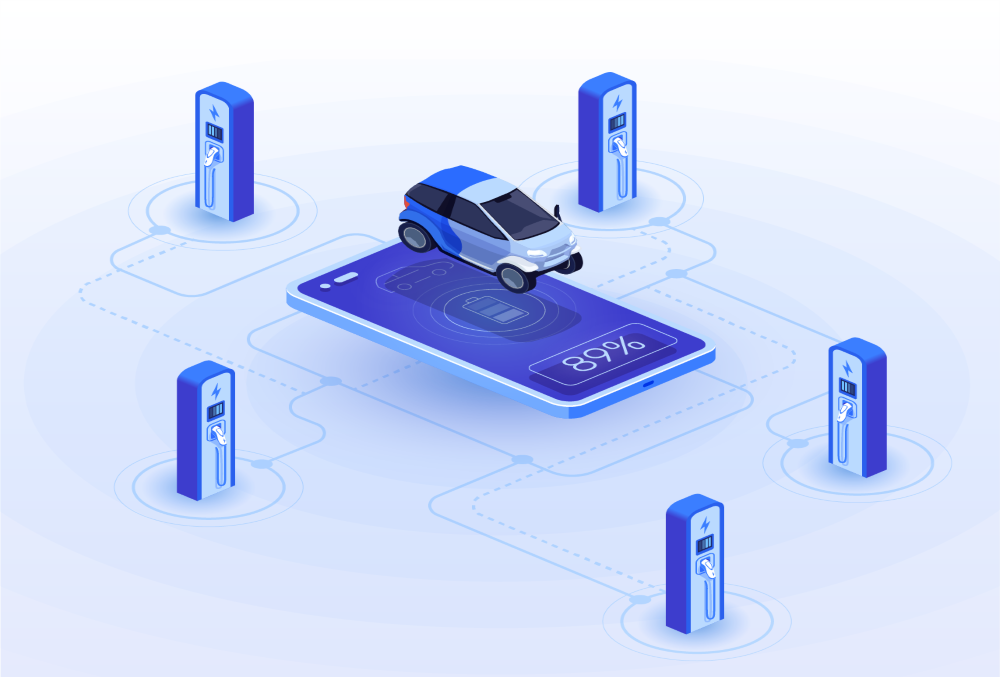
EV Charging Service Platform: The One That Sells for You, Not Just Runs for You
Most EV charging service platforms are operational tools. NetworkCore is the sales-channel layer that makes chargers visible across the whole ecosystem, drives utilisation, and turns visibility into revenue.

The conclusion first: most of what gets called an EV charging service platform is really an operational tool. It helps a Charging Partner run its chargers, monitor uptime, push firmware, manage energy, take payments. These are genuinely useful, but they are all cost-side services: they help you operate what you have built, and none of them brings you a single additional driver. The service a CPO actually needs most, and least often gets from a platform, is a sales channel, something that actively puts its chargers in front of drivers and fills them. That is the gap NetworkCore fills. It is an EV charging service platform whose core service is distribution: making your chargers visible across the whole ecosystem, driving the utilisation that decides your economics, and turning visibility into revenue. A platform that runs your chargers is valuable. A platform that sells them is the one that changes your numbers.
Two kinds of platform, and the one operators are missing
If you are a Charge Point Operator, you are already surrounded by platforms, and it is worth being clear about what kind each one is, because they do fundamentally different jobs.
Most of what is marketed as an EV charging service platform is operational. The charge station management system that monitors your hardware and pushes updates. The payment platform that processes transactions. The energy management system that shapes your load. These are the tools that keep a charging network running, and every operator needs them. But notice what they have in common: they all help you operate the chargers you already have and the demand you already get. They are excellent at running the network. They do nothing to grow it. They are cost-side infrastructure, and a network that has all of them, perfectly configured, can still sit half empty, because none of them brings a driver to the plug.
The second kind of platform is a sales channel: something whose job is not to run your chargers but to fill them, by putting them in front of drivers who would not otherwise have found them. This is the EV charging service platform that most operators do not have, because the category has been dominated by operational tools. And it is the one that matters most for the number every operator actually cares about, which is how full the chargers are. You can run a charging network beautifully and still fail commercially if nobody is using it. Running is necessary. Selling is what pays.
NetworkCore is the second kind. It is not another operational tool competing with your CSMS. It is the sales-channel layer that most operators are missing, delivered as a service on top of whatever operational platform you already run. The broader map of how the layers fit together is in The EV Charging Stack Explained.
Visibility is the service, and it drives the only number that matters
The core service a sales-channel EV charging service platform provides is visibility, and it is worth being precise about why visibility is not a vanity metric but a direct input to a CPO's economics.
A charger only earns when a driver uses it, and a driver can only use a charger they can find. In a fragmented market, most of the demand that could reach an operator's chargers is locked inside platforms the operator has no connection to: the drivers inside a fleet's system, an automaker's in-car navigation, a bank's app, a mobility platform. Those drivers cannot find the operator's chargers, because the operator is not visible to them. The chargers are invisible to most of the demand that exists, and invisible chargers sit empty.
An EV charging service platform built as a sales channel solves this by making the operator's chargers visible across all of that demand at once. Connected to NetworkCore, an operator's chargers become discoverable and accessible to every Distribution Partner on the network, the fleets, OEMs, fintechs, wallets, insurers, and mobility apps whose drivers were previously unable to find them. The operator goes from being visible only to its own app users and passing traffic, to being visible across the entire EV-driving population the network reaches.
And here is why that visibility is the service that matters: visibility drives utilisation, and utilisation decides everything in charging economics. A charger's profitability is dominated by how full it is, because its large fixed costs are diluted across however many sessions occur. More visibility means more drivers finding the charger, means higher utilisation, means the fixed costs are spread across more sessions, means better economics. The chain runs directly from visibility to revenue. An EV charging service platform that increases your visibility is not offering you a soft benefit; it is acting on the single variable that determines whether your assets pay off. The full treatment of why utilisation is decisive is in EV Charger Utilisation Rate.
More visibility, more revenue: the service made concrete
The value of a sales-channel EV charging service platform is best understood as a straight commercial line: it exists to convert your chargers into more revenue by making them more used.
The revenue logic is simple. Your chargers are a fixed asset with a fixed cost base. Every additional session on them, once the fixed costs are covered, is high-margin revenue, because the marginal cost of one more session is mostly just the energy. So the single most valuable thing any service can do for a CPO is bring more sessions. A sales-channel EV charging service platform does exactly that: it routes demand from a growing network of Distribution Partners to your chargers, and every driver it brings is an additional session, additional utilisation, and additional revenue on infrastructure you have already paid for.
This is a genuinely different value proposition from an operational platform. An operational platform helps you run your existing sessions more efficiently, which is worth something. A sales-channel platform brings you sessions you would not otherwise have had, which is worth more, because it grows the top line rather than trimming the cost line. For an operator whose chargers are underused, and in a slowly maturing market most chargers are, the service that brings more demand is worth far more than the service that shaves a little cost off the demand already there. The mechanics of how that demand reaches your chargers are set out in the EV charging demand platform guide.
The platform as the sales team you could never afford
There is a further dimension to what a sales-channel EV charging service platform provides, and it is one that especially benefits operators who are not the largest players.
Reaching all that fragmented demand directly would mean building a relationship with every fleet, every automaker, every app, and every wallet whose drivers might use your chargers. That is an impossible amount of business development for any single operator, and completely out of reach for a small or mid-size one. No CPO has the sales force to strike and maintain dozens of demand relationships across markets.
An EV charging service platform does this once, on behalf of every operator connected to it, and shares the result. NetworkCore builds and maintains the relationships with all those Distribution Partners, and any connected operator gains access to that pooled demand through a single connection. In effect, the platform is the sales team the operator could never afford to hire, working continuously to bring demand to its chargers. And crucially, a small operator connected to the platform reaches the same pooled demand as a large one. The sales-channel service democratises reach: you do not have to be big enough to have your own OEM and fleet deals, because the platform has them and shares them. This is the leverage a service platform provides, scale of reach without the scale of organisation it would normally require. The wider logic of pooling demand is in Demand Aggregation Platforms.
Delivered as a service, not more software to run
The word service in EV charging service platform matters, because how the value is delivered is as important as the value itself, especially for an operator that already has enough software to run.
NetworkCore delivers its sales-channel value as a service, not as another system for the operator to operate. There is no subscription fee. NetworkCore handles the integration itself, so connecting is not a technical project the operator has to resource. The compliance, the invoicing, the settlement, and the financial complexity are all handled beneath the integration, so the operator does not take on new operational burden in exchange for the demand. And NetworkCore earns a commission only when it actually delivers a session, so the service costs nothing to hold and only ever costs anything when it is actively producing revenue for the operator.
This is what makes it a service rather than a tool. The operator does not learn a new platform, staff a new function, or carry a new fixed cost. It connects once, keeps running its existing operational stack, and receives demand, visibility, and fast settlement as a service delivered on top. The operator is paid quickly, per session, at its own transparent public price, with everything difficult absorbed by the platform. An EV charging service platform that adds a sales channel without adding operational weight is one an operator can adopt with almost no downside. How that settlement works is covered in CPO Settlement Timing and EV Charging Financial Backbone.
It complements your stack, it does not replace it
To be clear about where a sales-channel EV charging service platform sits, NetworkCore is designed to complement the operational platforms an operator already runs, not to replace them.
You keep your charge station management system, because you still need to run your hardware. You keep your energy management, your existing roaming connections, and whatever else operates your network. NetworkCore is OCPI-native and sits alongside all of it, adding the sales-channel layer, the visibility, the demand, the fast settlement, on top of the operational foundation you already have. It is not a rip-and-replace decision. It is an addition: the one layer your existing platforms do not provide, plugged in beside them. This is the honest framing, and it is also the practical one, because an operator should not have to tear out working systems to gain a sales channel. The broader case for moving beyond roaming is made in Charging App vs Roaming Hub.
The position for CPOs
If you operate charging infrastructure, you almost certainly already have the operational side of an EV charging service platform: the tools that run your chargers, monitor them, and take payments. What you may not have is the side that sells them, the sales channel that actively brings drivers to your plugs and fills your bays. That is the service that moves your revenue, because it acts on utilisation, the one variable that decides whether your assets pay off.
NetworkCore is that service platform. It makes your chargers visible across a whole network of Distribution Partners, drives the utilisation that visibility produces, and turns it into revenue on infrastructure you have already built. It works as the sales team you could never afford to hire, it is delivered as a service with no subscription and no integration cost, and it complements the operational stack you already run rather than replacing it. The financial plumbing that makes this possible is unpacked in EV Charging Payments Explained and Cross Network EV Charging. The commercial shape of the network is explored in EV Charging Business Model Explained and Offer EV Charging Without Owning Chargers. How a partner can ship charging without building the underlying stack is described in EV Charging White Label Solution.
A platform that runs your chargers keeps your network alive. A platform that sells them makes it grow. Reach the team at networkcore.org to discuss what an EV charging service platform built as a sales channel would do for your revenue.